
Blog
How Many Cigarettes Can I Bring to Australia Duty Free?

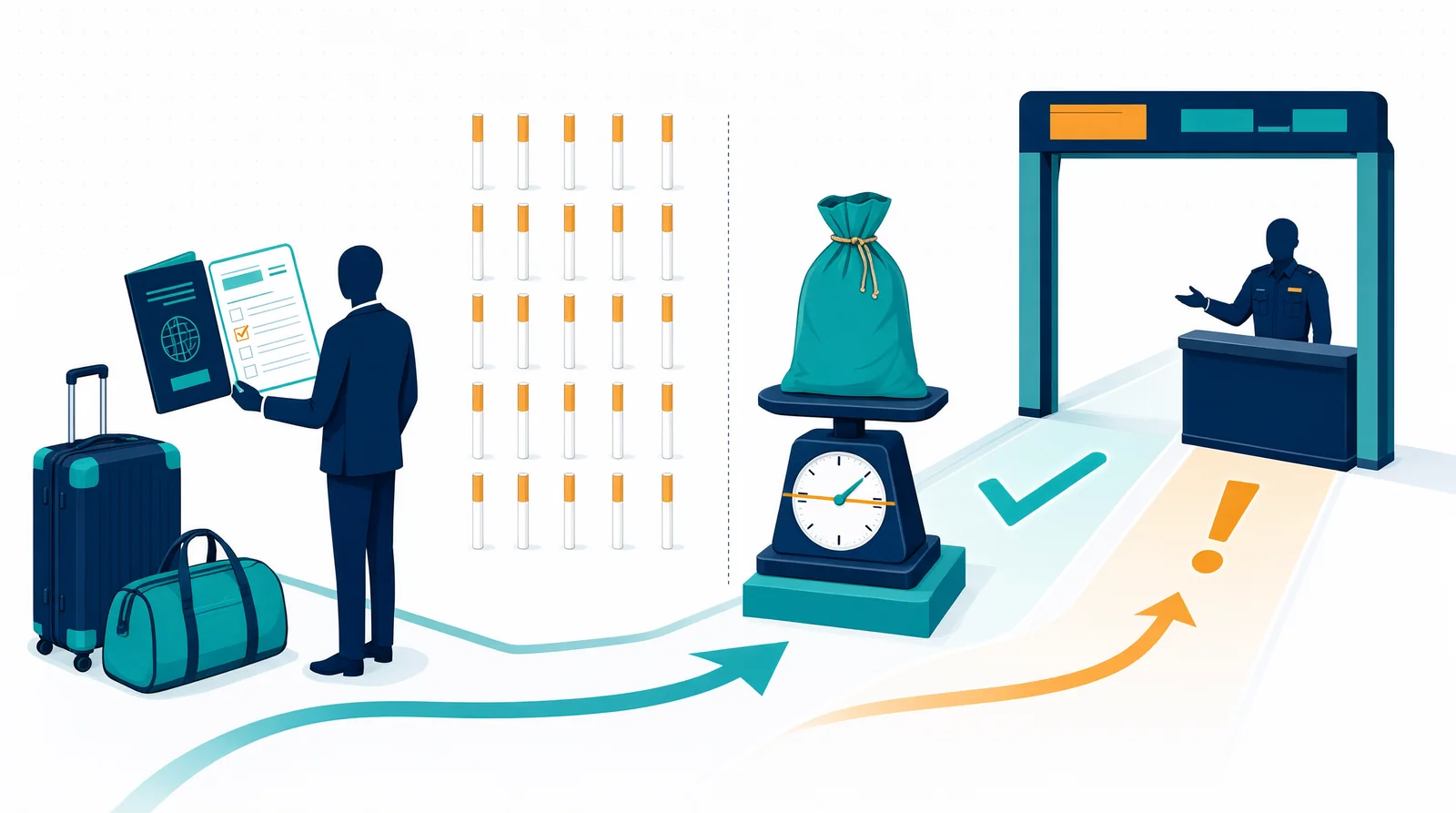
The Australia duty-free cigarette allowance is one of the most misunderstood border rules for arriving travellers — get it wrong and duty applies to everything you carry, not just the excess. This guide explains the Australia duty-free cigarette allowance in plain language, with the current ABF figures, a decision table and a declaration walkthrough.
Quick answer: If you are 18 or older, the Australian Border Force (ABF) currently summarises the tobacco duty-free concession as 25 cigarettes or 25 grams of tobacco. ABF’s detailed tobacco guidance describes the cigarette allowance as one unopened packet containing no more than 25 cigarettes, or the equivalent of 25 grams of other tobacco products, plus one opened packet of cigarettes.
The Australia duty-free cigarette allowance has a hard age gate: travellers under 18 do not receive a tobacco or alcohol duty-free concession. If you carry more tobacco than the applicable concession, you must declare it. ABF advises that duty and tax may then apply to all the tobacco you are carrying, not only the amount above the concession.
This guide covers tobacco carried by an arriving traveller for personal use. Posted items, unaccompanied baggage, commercial quantities and goods intended for resale may be subject to different import requirements.

What is Australia’s current duty-free cigarette allowance?
ABF’s high-level duty-free summary lists the tobacco concession for an eligible adult traveller as:
- 25 cigarettes; or
- 25 grams of other tobacco products.
ABF’s more detailed tobacco guidance explains the cigarette component as one unopened packet containing no more than 25 cigarettes, or the equivalent of 25 grams of other tobacco products, plus one opened packet of cigarettes.
The two ABF pages present the rule in slightly different formats. The safest approach is to read them together, retain the original packaging where possible and declare the tobacco if your situation does not clearly fit the published wording.
The word “or” is important. It should not be interpreted as permission to bring a full 25-cigarette allowance and an additional full 25-gram tobacco allowance at the same time.
Check the current wording directly on the:
Australia duty-free cigarette allowance: quick decision table
| Traveller or goods | General ABF position | Recommended action |
|---|---|---|
| Traveller under 18 | No tobacco duty-free concession | Do not count the traveller as holding a tobacco allowance. |
| Traveller aged 18 or older carrying cigarettes | ABF’s detailed guidance describes one unopened packet of no more than 25 cigarettes, plus one opened packet. | Keep the cigarettes identifiable and check the live ABF wording before departure. |
| Traveller aged 18 or older carrying other tobacco | Up to 25 grams under the published concession | Confirm the weight and retain the packaging or purchase receipt. |
| Traveller carrying mixed tobacco products | The allowance is not two separate full concessions. | Do not rely on your own conversion. Declare the goods and ask ABF. |
| Amount exceeds the applicable concession | Duty and tax may apply to all the tobacco carried. | Declare it accurately and keep proof of purchase available. |
| Posted, unaccompanied or commercial goods | The ordinary traveller concession may not apply. | Check the applicable import rules with ABF before sending or transporting the goods. |
This table is a screening aid, not a substitute for an ABF assessment of your goods at the border.
Why does the 18-year age threshold matter for the Australia duty-free cigarette allowance?
ABF states that people under 18 do not receive duty-free concessions for tobacco or alcohol. A child therefore contributes no tobacco allowance when a family calculates what it may carry.
Eligible adult family members travelling together may be able to combine their individual concessions under ABF’s family rules, but this does not create an allowance for a traveller under 18. Each traveller should still answer border questions accurately and make the goods available for inspection.
What happens if I exceed the Australia duty-free cigarette allowance?
Exceeding the concession does not automatically mean the tobacco is confiscated. However, you must declare it and allow ABF to assess the goods.
- Answer the Incoming Passenger Card accurately. Do not omit tobacco because it was purchased duty free overseas.
- Declare the goods to an ABF officer. If you are uncertain, declaration is the safer course.
- Present receipts or proof of purchase. This can help ABF determine the value and applicable charges.
- Be prepared for duty and tax. If you exceed the concession, ABF advises that charges can apply to all the tobacco you are carrying, not just the excess.
- Follow the officer’s directions. The final border assessment depends on the goods and circumstances presented.
Failure to declare goods accurately can lead to penalties or other enforcement action. Buying an item from an overseas duty-free store does not guarantee duty-free entry into Australia.
Cigarette pack size is not the same as the border allowance
Australian retail pack standards and the traveller duty-free concession are separate rules. A pack or carton size describes how cigarettes are packaged; it does not determine how many cigarettes a traveller may bring through the border without duty.
For example, a standard retail carton can contain far more cigarettes than the traveller concession. Do not treat “one carton” as a duty-free unit.
For the distinction between packets, cartons and Australian retail packaging rules, see our guide to how many cigarettes are in a pack in Australia.
Before-arrival checklist
- Confirm your age eligibility. Travellers under 18 have no tobacco concession.
- Count cigarettes and weigh other tobacco. Do this before reaching the border.
- Identify unopened and opened packets. ABF’s detailed wording treats them separately.
- Keep receipts and original packaging. They can help establish quantity and value.
- Separate personal goods from commercial goods. Traveller concessions are not intended for resale stock.
- Declare an excess or uncertain quantity. Do not assume that only the amount above the concession matters.
- Recheck the ABF website shortly before travelling. Border rules and administrative guidance can change.
If you are researching domestic retail costs after arrival, use our separate Australian cigarette price guide. Price information does not determine whether goods qualify for a border concession.
Health and illicit-tobacco boundaries
This article explains a border concession; it does not recommend smoking. Smoking is harmful, nicotine is addictive and tobacco use increases the risk of serious disease. Current public-health information is available from the Australian Department of Health, Disability and Ageing.
The duty-free concession also does not make illicit or unlawfully supplied tobacco legal. Information about Australia’s response to illicit tobacco is available from the Australian Taxation Office.
Airport, cruise and crew: does the allowance change?
The Australia duty-free cigarette allowance is the same whether you arrive by air or by sea — 25 cigarettes or 25 grams for each traveller aged 18 or older. What changes is the practical flow, not the number:
- Airports: declaration happens on the Incoming Passenger Card and at the red/green channel exit. Duty-free purchases made in the arrivals hall before immigration still count toward the allowance you are about to be assessed on.
- Cruise terminals: declaration happens on the same passenger card system, but tobacco bought aboard during the voyage is part of your total. Keep shipboard receipts so the assessment is quick.
- Aircrew and ship crew: crew concessions are assessed separately and are not a workaround for the traveller allowance; crew should follow their operator’s declaration guidance.
One scenario catches people out across all three: carrying cigarettes for a friend or relative who is travelling separately. The Australia duty-free cigarette allowance attaches to the person carrying the tobacco through the border, not to the person who paid for it or will smoke it. If it is in your bag, it is your declaration to make.
Likewise, unaccompanied or posted tobacco is outside the traveller framework entirely. Parcels are assessed under import rules, and the 25-stick traveller figure does not apply to them; if family overseas offers to post you cigarettes, that is a different concession system with its own thresholds and charges.
How to declare tobacco over the Australia duty-free cigarette allowance
Declaring more than the Australia duty-free cigarette allowance is a five-step process, and doing it correctly is far cheaper than being caught undeclared:
- Count everything before you fly. Include duty-free shop purchases made at departure, cigarettes bought on the plane, and any packs already in your bags. The ABF assesses the total tobacco you carry, not per receipt.
- Mark “Yes” for tobacco on the Incoming Passenger Card. The card asks directly about tobacco; answering yes is a declaration, not an admission of wrongdoing.
- Use the red channel or tell an ABF officer. Present the tobacco and your travel documents. The officer calculates duty and tax on the full quantity, because exceeding the concession voids the concession itself.
- Pay on the spot or by arrangement. Duty is assessed at current ATO rates; keep the receipt, because it is your proof of lawful entry.
- Keep quantities plausible for personal use. Commercial-scale volumes raise separate import questions that a traveller declaration does not cover.
If you are genuinely unsure whether your amount fits the Australia duty-free cigarette allowance, declare anyway. ABF’s own guidance treats an honest declaration far more leniently than a discovered omission.
Five common mistakes about the Australia duty-free cigarette allowance
- Counting packs instead of cigarettes. The Australia duty-free cigarette allowance is defined in sticks (25) and grams (25), not in packets — two opened 20-packs already exceed it.
- Assuming the concession resets per family member. Each adult traveller has an individual allowance; pooling into one suitcase does not pool the concessions.
- Believing duty applies only to the excess. ABF advises that once you exceed the concession, duty and tax can apply to all the tobacco you carry.
- Forgetting transit purchases. Cigarettes bought at a departure duty-free shop still count toward the allowance on arrival in Australia.
- Confusing the border allowance with pack-size rules. Standardised packaging governs retail sale inside Australia; the Australia duty-free cigarette allowance governs what crosses the border with you. They are separate rules.
One final planning note: because the Australia duty-free cigarette allowance is so small, most regular smokers travelling to Australia will legally bring in only about a day or two of personal supply. Knowing the allowance in advance is therefore less about maximising what you carry and more about avoiding an expensive mistake at the channel — and about deciding calmly, before you fly, what you will declare.
Related Halo guides
Once the border allowance is clear, these two guides answer the questions travellers usually ask next:
- How Many Cigarettes in a Pack? — Australian pack and carton sizes explained, so duty-free quantities are easier to picture.
- Cigarette Prices Australia: 2026 Tax & Cost Guide — how ATO duty rates translate into the retail prices you compare after arrival.
Frequently asked questions
Does the Australia duty-free cigarette allowance apply to vapes and e-cigarettes?
No. The Australia duty-free cigarette allowance covers tobacco products. Nicotine vaping goods follow separate therapeutic-goods rules, and personal importation limits differ; check both ABF and TGA guidance before travelling.
Can two adults travelling together combine their allowances into one bag?
No. The Australia duty-free cigarette allowance is individual to each traveller aged 18 or older. Carry your own tobacco through the border in your own baggage.
Is the Australia duty-free cigarette allowance the same at every border crossing?
Yes — the Australia duty-free cigarette allowance is a national concession, so Sydney, Melbourne, Brisbane, Perth and the cruise terminals all apply the same 25-cigarette or 25-gram figure.
Can I bring 25 cigarettes into Australia duty free?
If you are 18 or older, ABF’s summary currently lists 25 cigarettes as the tobacco concession. Its detailed guidance describes one unopened packet containing no more than 25 cigarettes, plus one opened packet. The concession remains subject to ABF’s conditions and border assessment.
Can I bring 25 cigarettes and 25 grams of tobacco?
Do not assume so. ABF uses the word “or”, indicating alternative forms of the tobacco concession rather than two automatic full allowances. If you are carrying mixed tobacco products, declare them and ask ABF to assess the combination.
Do travellers under 18 receive a tobacco allowance?
No. ABF states that travellers under 18 do not receive a duty-free concession for tobacco or alcohol.
Will I pay duty only on the cigarettes above the limit?
Not necessarily. ABF advises that when a traveller exceeds the tobacco concession, duty and tax can apply to all the tobacco carried, not only the amount above the limit.
Should I declare tobacco if I am unsure?
Yes. Answer the Incoming Passenger Card accurately and present the goods to an ABF officer. Declaration allows ABF to determine how the current rules apply to your circumstances.
How often does the Australia duty-free cigarette allowance change?
The Australia duty-free cigarette allowance is set by regulation rather than by annual budget announcement, so it does not move on a fixed calendar the way excise rates do. The figure was reduced sharply in past decades — from 250 cigarettes to 50, and then to the current 25 — which is why older travel advice online is so often wrong. Treat any page quoting 50 or more cigarettes as outdated, however official it looks.
Because changes arrive without much warning, the only reliable habit is to check the live ABF tobacco page within a week of departure. This guide is re-verified against that source on a regular cycle, and the verification date at the top of the page tells you exactly how fresh the figures are.
Research method
This guide was last checked on 14 September 2026. Halo’s editorial review used primary Australian government sources and compared ABF’s short duty-free summary with its detailed tobacco guidance.
- Quantities and age requirements were taken from current ABF material.
- The summary page and detailed tobacco page were compared because they express the cigarette allowance differently.
- Health information was separated from border guidance.
- Illicit-tobacco information was checked against the ATO.
- No duty or tax amount was estimated because the final assessment belongs to ABF.
Primary sources
- Australian Border Force — Duty-free categories
- Australian Border Force — Duty-free concessions
- Australian Border Force — Tobacco import guidance
- Australian Taxation Office — Illicit tobacco
- Australian Department of Health, Disability and Ageing — About smoking
Official-source information has been summarised in plain language. Where this guide and current government guidance differ, follow the government guidance and the directions of ABF officers.
Corrections: If an official rule has changed or you identify an error, please refer to the Halo Editorial Policy for our review and corrections process.
About this guide: This resource is maintained by the Halo Editorial Desk to make official Australian traveller information easier to understand. Product availability and commercial interests do not determine its border-rule conclusions.
